Each book on this list offers unique perspectives and valuable lessons for web entrepreneurs. If you are—or aspire to be—a web entrepreneur, these books can provide you with the tools, strategies, and inspiration you need to succeed in your projects.
Reading is essential for web entrepreneurs. It not only helps them acquire new skills, but also allows them to draw inspiration from the experiences of others
TOP 10 🏆 Books You Absolutely Must Read If You're a Web Entrepreneur.⬇
You can find each of these books📕 in paperback, Kindle, or audiobook🎙.
New Entrepreneurs
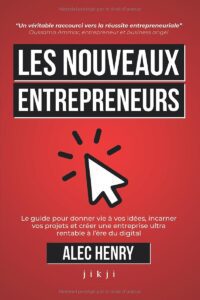
Do you dream of becoming an entrepreneur but don't know where to start? Do you have an idea, a project, or a passion, but don't know how to turn them into a profitable business that's suited to the digital world? Then this book is for you!
"New Entrepreneurs" is a practical and inspiring guide that walks you through your entrepreneurial journey step by step.
Here, you'll learn how to:
🟢Find Your Business Idea, Validate It, and Protect It
🟢Define your value proposition, your ideal customer, and your marketing strategy
🟢Create your service offering, your website, and your social media accounts
🟢Launch your business, test your market, and generate your first revenue
🟢Automate, delegate, and optimize your business
🟢Develop your mindset, confidence, and leadership skills
This book also gives you access to testimonials, advice, and resources from more than 50 successful entrepreneurs who started their businesses in the digital age. You’ll learn from their experiences, their mistakes, and their successes.
*The New Entrepreneurs* is the book you need to bring your ideas to life, make your projects a reality, and build a highly profitable business in the digital age. Don’t wait any longer—order it now and embark on this adventure!
Your Empire in a Backpack

Do you dream of starting your own business but don't know where to begin? Do you want to travel, work at your own pace, and make a living from your computer? Then this book is for you!
*Your Empire in a Backpack* is a practical and inspiring guide for anyone who wants to start an online business.
In this book, you'll learn how to:
🟢Unlock the secrets of human psychology to find a business idea that meets a real need and that you're passionate about.
🟢Create your website, online store, or blog in just a few clicks—no technical skills required.
🟢Use social media, SEO, email marketing, and advertising to attract qualified visitors and turn them into loyal customers.
🟢Automate and delegate repetitive tasks to save time and money.
🟢Manage your business remotely, choosing where and when you work.
"Your Empire in a Backpack" gives you everything you need to make your online business venture a success. Whether you're a student, an employee, a retiree, or unemployed, you can build your empire in a backpack and live the life of your dreams!
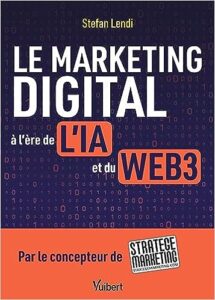
This book offers an innovative and strategic perspective on digital marketing at a time when artificial intelligence (AI) and Web3 technologies (blockchain, cryptocurrencies, NFTs, etc.) are transforming the digital landscape and consumer behavior.
The author explains how marketers can leverage these new opportunities to create personalized, interactive, and immersive experiences for their customers, while respecting their privacy and autonomy. He outlines the key principles of digital marketing in the age of AI and Web3, such as:
🟢The Importance of Data as a Strategic Asset and a Source of Insights
🟢Using AI to analyze, segment, predict, and optimize customer journeys
🟢Using Web3 to create decentralized, secure, and transparent ecosystems
🟢Implementing cross-channel, multi-format, and multi-device campaigns
🟢Creating engaging, authentic, and personalized content
🟢Measuring the Performance and Return on Investment (ROI) of Marketing Initiatives
The book draws on numerous real-world examples from various industries to illustrate best practices and pitfalls to avoid. It also offers practical advice and tools for implementing a digital marketing strategy in the age of AI and Web3, tailored to the needs and goals of each company.
This book is intended for all digital marketing professionals who want to learn about the latest trends and stand out in a competitive market. It will also be of interest to students, instructors, and researchers in marketing, as well as enthusiasts of digital technology.
That's Seth Godin's approach to marketing
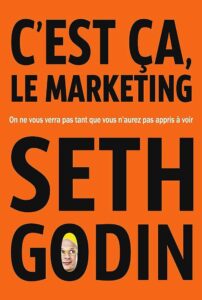
This is Seth Godin's take on marketing, written by the author himself. This book explains how to start your own online business using the principles of modern marketing.
You'll learn how to:
🟢Define your target audience and your unique value proposition
🟢Create high-quality content that attracts and retains your customers
🟢Use social media, blogs, podcasts, and newsletters to spread your message
🟢Build an engaged community around your brand
🟢Test, measure, and improve your results
🟢Develop a leadership and entrepreneurial mindset
This book is a practical and inspiring guide for anyone who wants to launch their own web project without needing a lot of resources or experience.
Whether you’re a student, an employee, a retiree, or just curious, you’ll find practical advice and real-life examples in this book to help you start your own business with just a backpack. That’s what marketing is all about: creating something that matters to you and to others, and sharing it with the world.
Lean Startup: Embrace Continuous Innovation
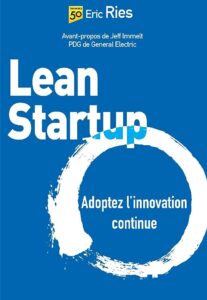
The Lean Startup is an approach to starting a business and launching products that emphasizes rapid experimentation, short development cycles, and continuous learning in order to adapt quickly to changing customer needs.
Instead of following a traditional planning process, startups should test their assumptions and either pivot or persevere based on what they learn.
Key points of the book:
🟢Start Small: Instead of spending a lot of time and money developing a final product, start with a «minimum viable product» (MVP). This allows you to quickly test your assumptions and get feedback from customers.
🟢Measure: Use actionable metrics to determine whether you're moving in the right direction. Avoid vanity metrics that don't give you a clear picture of reality.
🟢 Learn and pivot: Once you’ve received feedback, learn from your mistakes. If an assumption is proven wrong, «pivot» by making a fundamental strategic change, or «persevere» if you’re on the right track.
🟢Construction – Measurement – Learning: This cycle is at the heart of the Lean Startup approach. It aims to accelerate the feedback process in order to adapt quickly to customer needs.
🟢Continuous Innovation: Success does not lie in the ability to predict the future, but in the agility and adaptability needed to respond to the ever-changing challenges of the market.
🟢The Science Behind the Lean Startup: The approach relies on scientific experiments to validate or invalidate hypotheses. Each step, from the MVP to measuring results, is akin to an experiment.
Conclusion:
In a constantly changing world, success depends not so much on the perfection of an initial idea, but rather on the ability to learn and adapt quickly. Adopting a Lean Startup mindset and focusing on continuous innovation can reduce the risk of failure and lead to sustainable and successful growth.
Not everyone has had the chance to fail at school

In *Not Everyone Was Lucky Enough to Fail at School*, Olivier Roland challenges the traditional educational model and the conventional «long academic career—salaried job» path. In his view, this model isn’t right for everyone and can even be counterproductive for those with an entrepreneurial spirit.
Drawing on his own experience as a self-taught entrepreneur and numerous examples from other entrepreneurs, the author offers practical advice and techniques for achieving success outside the traditional educational system. He advocates for self-directed learning, the development of practical skills, and taking calculated risks.
The book is divided into several parts:
The first part is a critique of the education system, in which Roland argues that schools do not adequately prepare young people for the real world.
The second part presents a series of principles and ideas for those who wish to embark on a path toward entrepreneurship.
Part Three is devoted to case studies and real-life examples of entrepreneurs who have succeeded without following the traditional path.
Finally, the last section offers advice and resources for those who want to start a business or begin investing.
Throughout the book, Roland encourages readers to adopt a mindset of continuous learning, not to be afraid of failure, and to view the world as a playground full of opportunities. He also emphasizes the importance of freedom, passion, and curiosity on the entrepreneurial journey.
In short, *Not Everyone Has Had the Chance to Fail at School* is a call for a different approach to education and success—one centered on the individual, their passions, and their entrepreneurial abilities.
The 4-Hour Workweek

*The 4-Hour Workweek* is clearly the go-to book for all web entrepreneurs. What does the book promise? Work less, earn more, and live better.
If you dream of breaking free from the daily grind of commuting, working, and sleeping—and making money online—or if you simply want to live better by working less, this book is for you.
This book teaches you how to break free from the routine of a traditional 9-to-5 job, automate your income, and live more freely.
Key Points :
Definition of «Nouveau Riche» : Instead of working his entire life only to retire at the end, the «New Rich» organizes his life so that he can enjoy «mini-retirements» throughout his life.
🟢D.E.A.L. : An acronym that stands for the steps to achieving the 4-Hour Workweek:
🟢D for Delegation : The Art of Delegating Tasks.
🟢E for Elimination : Get rid of unnecessary tasks and obligations.
🟢A stands for Automation : Set up systems so that things run smoothly without constant intervention.
🟢L for Libération : The freedom to choose when and where you want to live.
🟢Phobia Test : Before trying out a new idea or taking a risk, Ferriss suggests asking yourself what the worst-case scenarios might be and how you could handle them. Often, the perceived risks are greater than the actual risks.
🟢Automation and Delegation : Use tools and resources such as outsourcing to free up time. Ferriss discusses the importance of hiring virtual assistants, for example, to handle daily tasks.
🟢The Concept Behind the Museum : Instead of accumulating material possessions, focus on collecting experiences.
🟢Reduce interruptions : Avoid constant emails, unnecessary meetings, and other distractions that hinder productivity.
🟢Setting Up an Automated Business : The goal is to build a business that can run without you, generating passive income.
Conclusion : The book emphasizes challenging social norms regarding work, success, and happiness. Instead of putting off the life you dream of until retirement, Ferriss suggests taking steps right now to live life to the fullest—by working less and enjoying life more. It’s an invitation to radically rethink the way we live and work.
Next-Generation Business Model
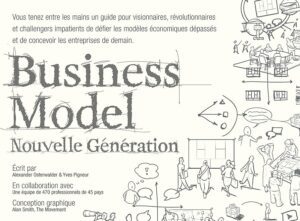
The book *Business Model Nouvelle Génération* is actually the French translation of the book *Business Model Generation* by Alexander Osterwalder and Yves Pigneur. This is a guide for visionaries, revolutionaries, and trailblazers who want to challenge outdated business models and shape the companies of tomorrow.
Here is a summary of the book:
«Next-Generation Business Model» offers a systematic and visual approach to the design and innovation of business models. It is based on the concept of the «Business Model Canvas,» which is a framework consisting of nine basic building blocks. These blocks cover the four main areas of a business: customers, offering, infrastructure, and financial viability.
The book guides readers through a methodology for creating, analyzing, and reinventing business models. It offers numerous examples, case studies, and techniques to help entrepreneurs and innovators think outside the box and develop sustainable and profitable business models.
In short, «Next-Generation Business Model» is an indispensable tool for any entrepreneur, manager, or innovator who wants to understand, create, or reinvent a business model.
’Next-Generation Business Model" is a comprehensive guide for visionaries, revolutionaries, and challengers. Today, new industries are emerging while those of the past are collapsing. Young players are challenging traditional players, some of whom are struggling to reinvent themselves and remain competitive. New business models are emerging and challenging established principles, opening up new avenues…
In this book, you'll learn how to turn your ideas into revolutionary, profitable, and—above all—scalable business models.
"Next-Generation Business Model" is undoubtedly the most informative book you'll read on how to build an online business that generates more than 100K a year.
The Richest Man in Babylon

🟢The Richest Man in Babylon is a classic written by George S. Clason. First published in 1926, this book uses parables set in the ancient city of Babylon to convey fundamental lessons about finance and wealth creation.
Here is a summary of its main takeaways:
🟢Start building your savings : A portion of everything you earn is yours. Set aside at least 10% of your income before spending anything.
🟢Keep track of your expenses : Don't let your unnecessary desires overshadow your basic needs. Learn to live within your means.
🟢Make Your Treasure Grow : Invest your savings wisely so that they earn interest and grow over time.
🟢Protect your treasure from being lost : Avoid investments that seem too good to be true. Consult experts before investing.
🟢Turn Your Home Into a Profitable Investment : Living in a place that can also serve as an investment can offer financial benefits.
🟢Secure an income for the future : Think about retirement and how you can continue to earn an income, even when you're no longer actively working.
🟢Improve Your Ability to Win : Educate yourself and develop skills to increase your value in the job market.
The book demonstrates that financial success does not necessarily depend on how much money one earns, but on how one manages, saves, and invests that money. The timeless financial principles presented in *The Richest Man in Babylon* remain relevant even in the modern era.
The Startup Founder's Handbook
The Startup Founder's Handbook (The Startup Owner’s Manual (in English) is a step-by-step guide to building a successful business. Steve Blank and Bob Dorf, drawing on their extensive experience as entrepreneurs and educators, detail the Customer Development process, a methodological approach to developing and scaling a startup.
The book is divided into several key stages:
🟢Customer Discovery : The stage where entrepreneurs test their hypotheses about their potential customers and the market.
🟢Customer Verification : After identifying who their customers are, entrepreneurs validate the product to ensure that it meets the market's needs.
🟢Creating a Customer : This step focuses on growth and how to acquire, retain, and develop customers.
⭐Read reviews of the book on Amazon⭐
🟢Building the Company : Once you've validated the idea and built a customer base, it's time to move on to expansion.
The handbook also emphasizes the importance of adaptability. Startups must be prepared to pivot—that is, to change course based on customer feedback and market trends.
With checklists, case studies, and practical advice, this book is an indispensable tool for any entrepreneur looking to launch a new business effectively and successfully.
This summary provides a general overview of the book, but to gain a complete understanding of the concepts and methodologies, it is recommended that you read the book in its entirety.
We recommend choosing the books that best suit your current needs and revisiting this list as those needs change. Happy reading!